A growing brand's plain-English guide to dual-marking, symbology choice, and the packaging lead time you should plan around.
Whether you sell supplements, pet food, coffee, or snacks, you are already stretched on packaging, regulatory work, and shelf space, and now the 2D barcode shift is landing on your desk too. The risk is treating a printing transition as a deadline to panic about rather than a capability to plan for. Brands that panic overspend and miss the operational wins. Brands that plan protect their margin and clear retail without drama.
This guide cuts through the noise on Sunrise 2027, dual-marking, and Variable Data Printing, so you can build a transition that protects margin and unlocks batch-level recall precision. It is written from the packaging side of the line: what your pack needs to carry, and how to get the artwork right. Setting up your GS1 Digital Link and generating your codes is a job for you and GS1; making sure your packaging carries a clean, scannable code is where we help.
Treat Sunrise 2027 as a capability milestone, not a deadline
Sunrise 2027 is the global GS1 target for retail point-of-sale systems worldwide to be capable of reading both traditional 1D barcodes and 2D barcodes by the end of 2027. Read that twice. It is a capability milestone for POS systems, not a hard cutoff for brand packaging. There is no statutory mandate that forces every brand to switch by that date, and no universal fine for not switching.
In practice, UK retailers will read both formats for years to come. Most brands should plan a dual-marking transition where the 1D EAN or UPC code sits alongside the 2D code on the same pack, then continue dual-marking for years after 2027 until retail POS fleets are fully 2D-capable. Drop the 1D too early and you risk checkout failures at retailers whose systems have not upgraded.
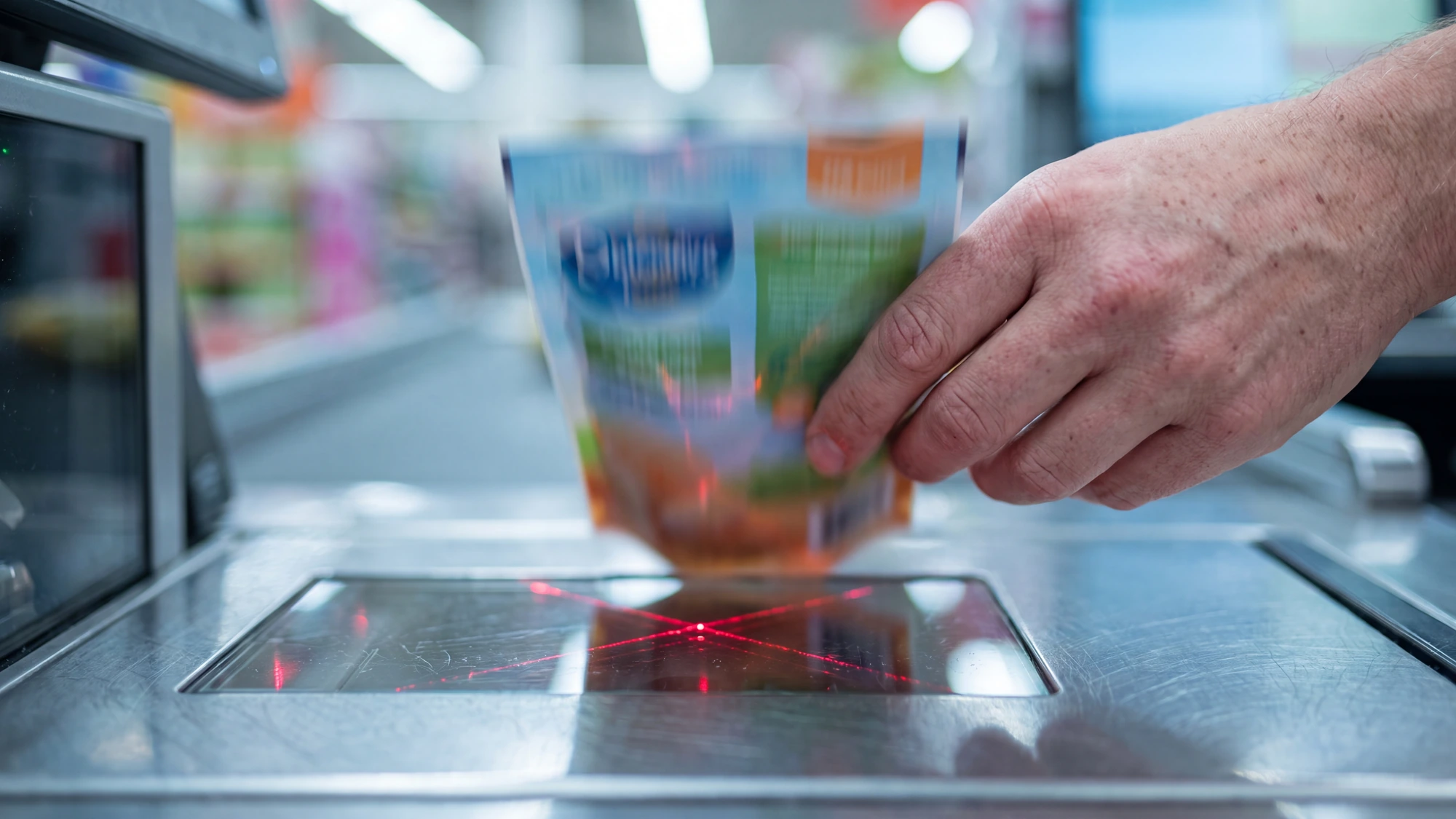
The pressure is real even though the rule is voluntary, because it is retailer-driven. UK retailers are already piloting 2D-only codes on own-label lines, and the driver is rarely marketing. It is operational: waste reduction through expiry-date scanning at the till, and tighter traceability. When a major retailer decides it wants 2D-ready products on its shelves, voluntary becomes effectively mandatory for its suppliers. The practical risk for a brand that does nothing is not a checkout failure. It is being deprioritised, delisted, or charged back by a retailer that has moved.
The lesson is direct, whatever you sell. This is not a marketing project. It is an operational one.
Plan for batch-level recall precision before the next complaint hits
When contamination, mislabelling, or quality failures come to light, brands need to identify and withdraw specific batches. The regulatory expectations around recall sit with your category compliance work, not with your packaging supplier. The packaging question is narrower and concrete: can your pack carry batch-level identification at all?
With a 1D barcode, all you encode is the GTIN. That tells a retailer "this is product X" but nothing about which batch, which production run, or which expiry window. When a complaint escalates to a recall, a brand without batch-level identification on pack is forced to pull entire product lines. Every SKU, every shelf. The cost compounds fast through retail charges, write-offs, freight, and brand damage.
A 2D barcode changes the maths. A GS1 QR or DataMatrix code can carry the GTIN, batch number, and expiry date in a single symbol. When a recall is triggered, only the affected batches need to be identified and withdrawn. Product on shelf from a clean batch keeps selling.
The recall triggers vary by category but the exposure is shared. Supplements face potency failures and allergen cross-contamination; pet food faces ingredient and contamination recalls; coffee and snacks face allergen and foreign-body issues. In every case, the ability to carry batch data on pack is a margin-protection feature, not a nice-to-have. The packaging decision is making sure the pack and the print method can carry that data cleanly.
Want to talk through 2D barcode artwork on your packaging? Request a Quote and we will walk through the options.
Decide between static and dynamic data early
There are two ways to put a 2D barcode on a pouch, bag, or sachet, and the choice shapes your cost base, your supplier brief, and your operational complexity.
Static data. A pre-printed code containing only the GTIN. The same code appears on every pack of that SKU, printed at the converter during the regular print run. No special equipment needed at filling. Lower cost and simpler operations, but you lose the batch and expiry encoding. You get a 2D code that scans at POS and links to consumer content, but no recall precision.
Dynamic data. A code applied at your filling line that includes GTIN, batch number, and expiry date. This requires on-line Variable Data Printing (VDP) using thermal transfer overprint, thermal inkjet, or laser marking, integrated with your ERP or production system. Higher capital investment, but every pack carries unique batch and expiry information.
Within a packaging quote, dynamic data adds consumables such as variable-data ink or ribbons, and incremental time at the printing stage. Static data sits within standard quote composition. Talk to your packaging partner about both routes at the quote stage so the cost picture is clear before you commit to a filling line investment.
For brands targeting major UK retailers, dynamic data is usually where the long-term value sits. Pre-printed static codes are a sensible stepping stone, not the destination. If you are on contract manufacturing, ask your co-packer directly what VDP capability they have on your line. If the answer is none, you will either brief them to upgrade or plan to bring the relevant filling work in-house.
Choose GS1 QR with Digital Link for consumer packs
Picking the right symbology matters more than most founders realise. Get it wrong and you either over-engineer for invisible benefits or under-engineer and lose retail acceptance.
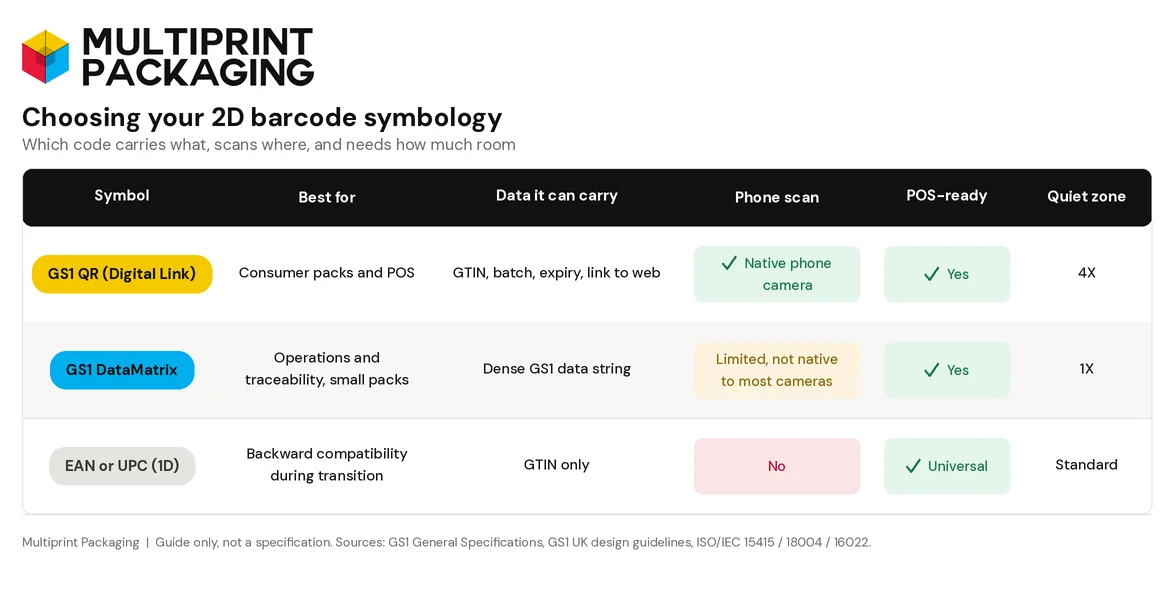
For most consumer packs, whether stand-up pouches, flat bottom bags, sachets, or bottles, GS1 QR with Digital Link is usually the clear answer. One code scans at the till and directs the consumer's phone to a product webpage, which might host ingredient sourcing detail, usage guidance, batch certificates of analysis, or customer support links. One code, two jobs.
GS1 DataMatrix is the right call where pack space is tight, such as stick packs and small sachets, or where the use is operational rather than consumer-facing.
Whichever you choose, keep your 1D EAN or UPC barcode on the pack during the transition. Do not retire it until your major retail partners confirm their POS fleets are fully 2D-capable.
Planning dual-marked artwork? Request a Quote to confirm pouch tooling that accommodates both codes cleanly.
Match your artwork to ISO/IEC 15415 grades before sending to print
This is where brands lose money fast. Print quality determines whether your 2D code scans reliably at POS, and a code that fails at the till is a code that costs you retailer relationships.
The standard for 2D barcode print-quality verification is ISO/IEC 15415. Grades run from 4.0 (best) to 0.0 (fail). The widely used benchmark for retail and supply-chain scannability is a minimum grade C (2.0) or higher across your production runs.
Three artwork rules matter most:
X-dimension. GS1 specifies that 2D QR and DataMatrix symbols are printed at 1.5 times the equivalent X-dimension allowed for the linear barcode, to account for optical effects in image capture. In plain terms, the 2D code needs to be sized correctly relative to the 1D code on the same pack, not shrunk to fit.
Quiet zones. A GS1 QR code requires a clear quiet zone of 4X around the symbol; DataMatrix requires 1X. Do not crowd the code with copy, finishes, or pack edges. It is good practice to allow a little more than the minimum to absorb production tolerances.
Verification on the real substrate. Ask your packaging supplier for an ISO/IEC 15415 verification report on production samples, not just artwork mock-ups. Verification on the substrate and finish you are actually shipping is what counts, because contrast and modulation change with material and gloss.
If a packaging supplier cannot provide a verification report on the production substrate, treat that as a signal. The whole investment in 2D fails the moment a major retailer flags scan failures on your packs.
Build your dual-marking timeline now
A full packaging transition typically needs 18 to 24 months from first decision to validated, live artwork at scale. That is not a padded estimate. It reflects the genuine process time for artwork changes, print trials, verification, and, for dynamic data, filling-line integration. For brands using co-manufacturers, coordinating those changes across multiple sites takes longer still. Beginning in mid-2026 for an end-2027 horizon is tight, which is why the planning year is now.
Most growing brands should plan in three phases.
Phase 1 (0 to 6 months). Audit your SKUs. Pick a pilot range of 6 to 12 SKUs, not your full line. Decide static versus dynamic. Brief your packaging supplier on dual-marking artwork. Confirm your GS1 UK membership and GTIN allocation directly with GS1 UK, since membership and allocation tiers are set by them.
Phase 2 (6 to 12 months). Pilot the dual-marked pack across the selected SKUs. Run print trials, validate the verification grades, and confirm POS read parity with the 1D code. If you are going dynamic, integrate your production and label-management systems.
Phase 3 (12 to 24 months and beyond). Scale across the range. Train operations teams on verification sampling. Track POS read rate, verification grade distribution, and recall precision. Plan for eventual 1D retirement only once retail confirms full 2D capability, which will be well after 2027.
The longest-lead item is usually the packaging redesign and print trials, so start there. Brands moving now will have validated dual-marked artwork live by the time UK retail flips its POS readiness switches.
Ready to begin your audit? Request Plain Stock Pricing for a sample pack to test current artwork specs.
Ready to plan your Sunrise 2027 transition?
The cost of starting now is an artwork redesign and a few months of pilot production. The cost of leaving it to 2027 is a rushed transition, broken POS scans, and pulled retail listings during your busiest sales quarter.
Request Plain Stock Pricing to get samples in your hands, or Request a Quote to plan your 2D barcode packaging transition.

Read next
More articles from our team





Get the next post in your inbox
Compliance updates, lead-time news, and packaging guides. One email, no spam
Ready to spec your pouch?
Get a quote for your format and see lead times for your region
Start your order
Whether you need custom print or plain stock, we've got lead times that work