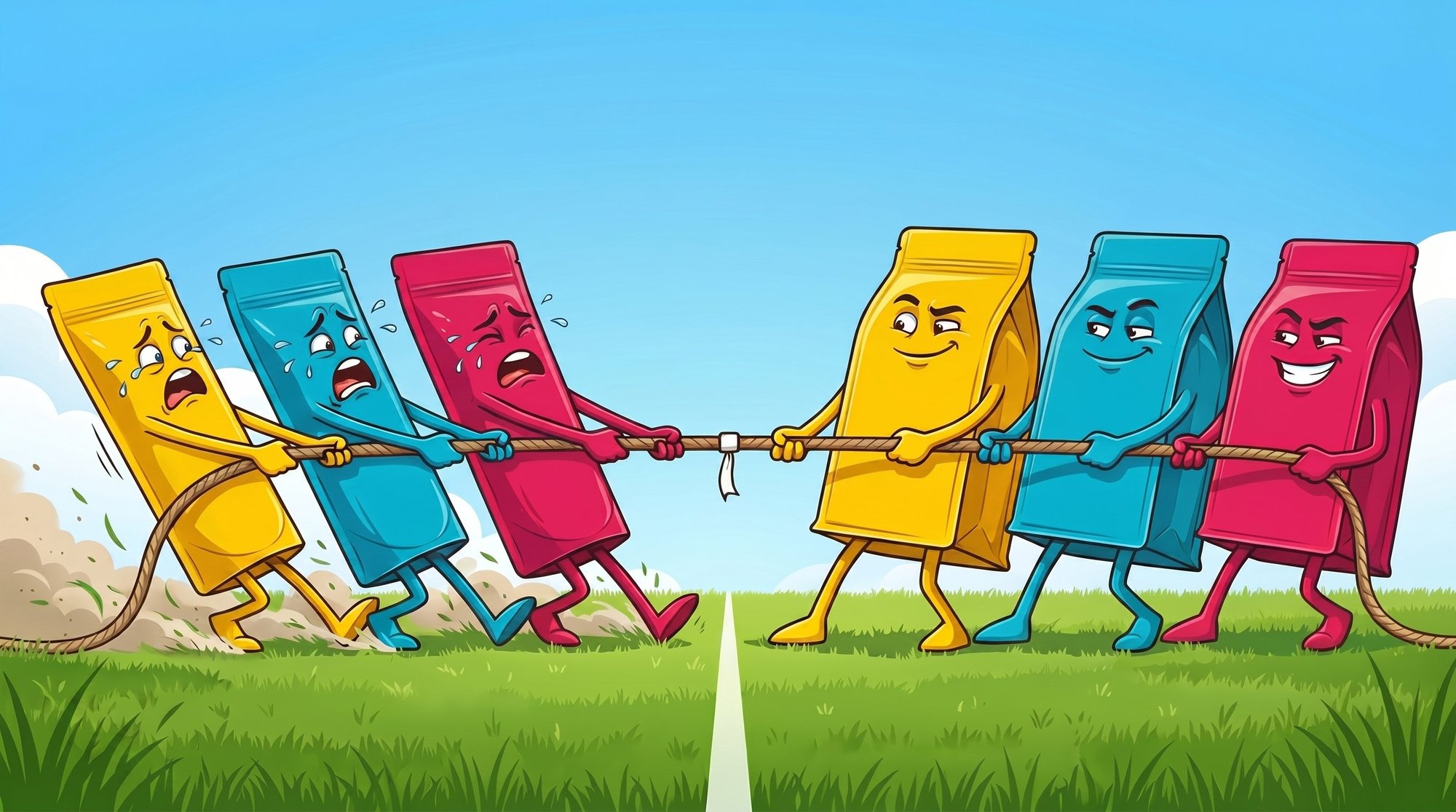
Your packaging format is not just an aesthetic choice. It dictates your footprint on the retail shelf, determines your fill line compatibility, limits your printable real estate, and signals your product's value to the consumer before they ever read a label. Format choice is one of the most consequential decisions a growing CPG brand makes.
The stand-up pouch (SUP) is the industry default for good reason. It is a proven, accessible format with universal consumer familiarity. But there is a point in every premium brand's growth where the standard stand-up pouch starts working against you rather than for you. It leans, it bulges at high fill weights, and it gets lost on crowded shelves.
If you are currently evaluating a flat bottom pouch vs stand up pouch UK transition, whether pushed by a retailer, a competitor, or your own brand ambitions, this guide breaks down exactly when to make the switch, where flat bottom wins, and when sticking with a stand-up pouch is still the smartest commercial call.
Why the Format Decision Matters More Than Most Brands Realise
When a founder first launches a product, the packaging priority is speed to market and validation. The stand-up pouch is perfect for this phase. It is universally compatible with co-packers, requires minimal capital investment, and is understood by every consumer.
However, as a brand scales into major retail or pushes into premium pricing tiers, the packaging format becomes a structural constraint. A stand-up pouch has two primary display panels (front and back) and relies on a bottom gusset to stay upright. At low fill weights, it stands well. But as you increase the product volume, the physics of a two-panel bag start to fail. The pouch bulges in the middle, the base rounds out, and the bag leans backward on the shelf.
You end up paying for premium artwork that is pointing at the ceiling instead of the customer.
This is the inflection point. This is when brands start looking at the flat bottom format not as a luxury, but as a merchandising necessity.
What Makes Flat Bottom Pouches Different
What is a flat bottom pouch?
A flat bottom pouch (sometimes called a box pouch or block bottom bag) is engineered differently from a stand-up pouch. While a SUP is essentially two panels joined at a bottom gusset, a flat bottom pouch is a true 5 or 6-panel construction: front, back, two side gussets, a completely flat base panel, and an optional top panel (if using a pocket zipper).
The Base Panel Changes Everything. Because the base is a separate, flat piece of material, the pouch sits perfectly square on the shelf. It does not lean, it does not rock, and it does not require a cardboard display tray to keep it upright. It provides a consistent, billboard face-out presentation at all times.
Print Real Estate. A stand-up pouch gives you two panels to tell your story. A flat bottom pouch gives you four to five printable panels. You can place your brand story on the back, your nutritional compliance data on one side gusset, and your sustainability credentials on the other, leaving the front panel completely clean for high-impact branding.
The Premium Signal. Consumers and retail buyers have come to associate the flat bottom format with higher quality. When you apply premium finishes, like a soft-touch matte laminate with spot UV gloss highlighting, the sharp, box-like edges of a flat bottom pouch catch the light differently than the rounded edges of a stand-up, amplifying the premium feel.
Zipper Position and UX. On a standard stand-up pouch, the zipper sits near the very top of the bag. On a flat bottom pouch, the zipper is often integrated into the front panel or sits as a wide-mouth pocket zipper. This creates a much more natural opening height and a significantly better user experience for scooping out product, especially on larger bags.
Category Fit: Where Flat Bottom Wins
Certain product categories have already established the flat bottom pouch as the baseline expectation for premium positioning.
Coffee
The speciality coffee sector established the flat bottom format as the premium standard. Independent roasters moved to flat bottom bags to visually differentiate their single-origin beans from the stand-up pouches and quad-seal bags used by supermarket own-labels. The mandatory one-way degassing valve sits perfectly flush on the structured front panel of a flat bottom bag. Today, any coffee brand positioning above a commodity price point should default to a flat bottom format.
Pet Food (Dry)
If you walk the aisles of an independent pet specialist, flat bottom is the dominant format for premium dry kibble. Pet food brands invest heavily in artwork, and that investment is wasted on a two-panel stand-up pouch that bulges and leans. Buyers at specialist chains increasingly expect premium pet food packaging formats from brands seeking top-tier shelf placement.
Nutritional Supplements
As the sports nutrition market matures and brands transition away from rigid tubs, the flat bottom pouch is separating the premium tier from the commodity tier. For protein powders, collagen, and greens blends, the flat bottom pouch provides the structural stability of a tub with the logistical benefits of flexible packaging. Brands using flat bottom are consistently outperforming their stand-up competitors in premium retail environments.
Broader CPG
Whether it is artisan pasta, premium granola, or functional baking mixes, any category where the brand is pushing toward a premium price point benefits from the structural authority of a flat bottom pouch.
Not sure which format fits your retail strategy? Request a quote and we'll talk through the options with you.
Large Format Bags: Where Flat Bottom Is the Only Sensible Choice
When you move beyond 1.5kg of product, the format decision is no longer about aesthetics. It is about physics.
What size bags work best in flat bottom format?
At 1.5kg and above, standard stand-up pouches lose their structural integrity. The weight of the product forces the bottom gusset to round out, causing the bag to fall over or lean heavily against its neighbour.
Weight Class Guide:
- Under 500g: Stand-up. Stable, accessible, easy to fill.
- 500g to 1.5kg: Stand-up works. Flat bottom starts winning on stability and shelf presence as you climb through this range.
- 1.5kg to 3kg: Flat bottom is the clear choice. A 2kg supplement pouch or pet food bag in a flat bottom format stands perfectly square and justifies a premium price.
- 3kg to 6kg: Flat bottom with a reinforced base gusset. The 6-panel construction is built to handle this specific weight class.
- Above 6kg: Flat bottom is no longer the right call. At 10kg or 15kg, you need a heavy-duty quad seal bag or a side gusset bag designed for bulk transport rather than retail display.
Ready to make the switch?
Multiprint works with UK brands transitioning from stand-up to flat bottom through our supplier partners in the EU and Asia.
Lead times from artwork approval:
- Rollstock (UK or EU): 10-15 days
- Stand-Up Pouches (UK or EU): 15-20 days
- Stand-Up Pouches (Asia): 20-25 days
- Flat Bottom Pouches (EU or Asia): 25-40 days
Flat Bottom Pouches are not manufactured in the UK.
Talk to us about your format and timeline before assuming it is not achievable.
When Stand-Up Is Still the Right Call
To be clear: stand-up pouches are not inferior to flat bottom pouches. They are simply engineered for different commercial realities. Credibility requires honesty, and there are many scenarios where sticking with a stand-up pouch is the smartest decision a brand can make.
When should I use a flat bottom bag instead of a stand-up pouch?
You should stick with a stand-up pouch when:
- Your product is under 500g. At 250g or 300g, the weight and fill volume make the stand-up pouch entirely stable and appropriate.
- You are a pure DTC brand. If your product is sold exclusively online, shelf presence and the "billboard effect" are irrelevant. The consumer never sees the product standing on a retail shelf alongside competitors.
- You are in the launch phase. When speed to market, format validation, and rapid artwork iteration matter more than premium retail signalling, the stand-up pouch is the right tool for the job.
- Your fill line is constrained. If your co-packer's filling line is configured exclusively for stand-up pouches, the volume must justify the capital investment required to retool for flat bottom.
- You are producing treats or samples. For single-serve formats, pet treats, or gifting ranges, a small stand-up pouch is the most practical and cost-effective choice.
- Your retail shelf depth is shallow. Flat bottom pouches generally require more shelf depth (front-to-back) than a standard stand-up pouch. If your target retailer has very shallow shelving planograms, a flat bottom bag may physically not fit.
A note on MOQ: Minimum Order Quantity is not the primary driver of the flat bottom vs stand-up decision. Multiprint's three routes to market are all accessible at a low entry point, and both formats are reachable from each: plain stock for sampling, custom print on a standard tooled size, and custom print on bespoke dimensions. The decision should be driven by weight class, retail environment, and brand positioning, not by how many units you are ordering.
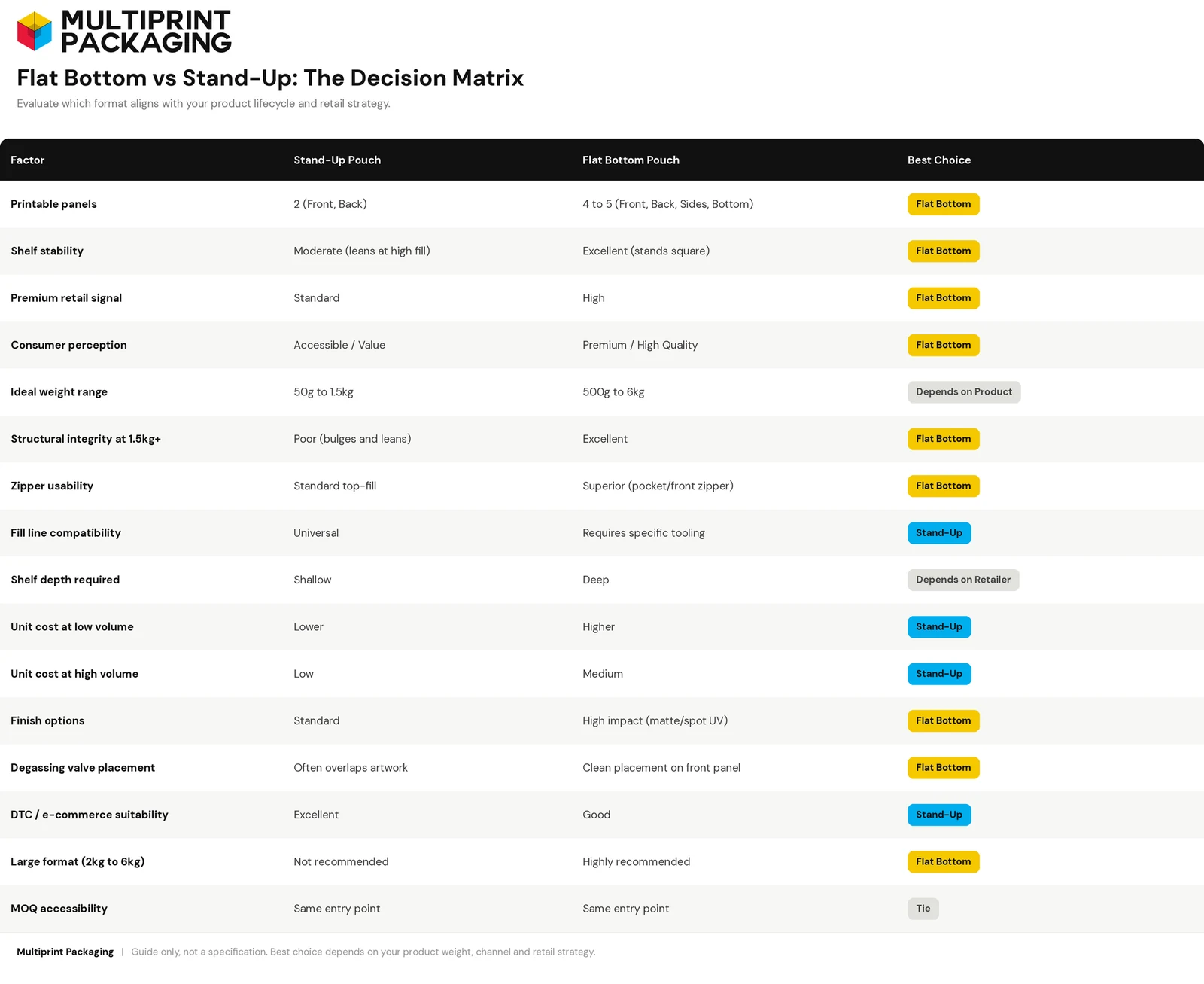
Flat Bottom vs Stand-Up: The Decision Matrix
Use this matrix to evaluate which format aligns with your current product lifecycle and retail strategy.
The stand-up pouch had a good run.
But as your brand scales, especially at 1.5kg and above, the physics start working against you. It leans. It bulges. It loses the shelf presence you paid for in your artwork.
If you are ready to upgrade your packaging format to match the quality of the product inside, we can help. We guide UK brands through the transition from stand-up to flat bottom every day, ensuring the right barrier specs, the right finishes, and the right timeline. Request Plain Stock Pricing to get samples in your hands, or Request a Quote to talk through your project.

Read next
More articles from our team



Get the next post in your inbox
Compliance updates, lead-time news, and packaging guides. One email, no spam
Ready to spec your pouch?
Get a quote for your format and see lead times for your region
Start your order
Whether you need custom print or plain stock, we've got lead times that work