
Why traditional minimum order quantities trap your cash, and how to size a packaging order around how you actually sell.
You found a packaging supplier, you liked the samples, and then the quote landed: a minimum order of ten thousand units per design. For a growing brand testing a new flavour, a new SKU, or a new market, that is not a minimum order. It is a cash-flow trap.
Pay it, and you have tied up a large slice of your working capital in a single design that has to sit in a warehouse and sell through before you see the money again. Worse, if the formula changes, the branding gets a refresh, or the SKU underperforms, you are left with thousands of pouches you cannot use. The minimum order quantity (MOQ) is one of the most common ways a growing brand quietly damages its own cash position, and most founders accept it because they assume it is just how packaging works.
It is not. This guide explains why traditional MOQs are so high, what that does to your cash, and how to size a packaging order around your actual sales rhythm instead of a printer's convenience.
Why traditional packaging MOQs are so high
To understand the trap, you need to understand where the minimum comes from. A traditional printer's MOQ is not arbitrary, and it is not a conspiracy against small brands. It is a direct consequence of how the press is set up.
Older and higher-volume print methods carry a large fixed setup cost per design before a single usable pouch comes off the line. That cost has to be spread across the run. If the setup is expensive, the only way to make the per-unit price look reasonable is to print a very large quantity, which is why the minimums climb into the tens of thousands. The printer is not over-charging; the economics of that press simply do not work at low volumes.
The problem is that this maths was built for established brands ordering one proven SKU in bulk. It was never built for a growing brand that needs to test, iterate, and launch several SKUs without betting the company on each one. When a supplier quotes you a five-figure minimum, what they are really telling you is that their press is the wrong tool for where your brand is right now.
The arrival of digital print changed this. Because digital has little to no fixed setup per design, short runs become genuinely viable, which is what makes a low entry order possible at all. The right supplier matches the press to your run rather than forcing your run to fit the press.
What a high MOQ really costs you
The damage from an oversized order is not just the invoice. It is everything that invoice locks up.
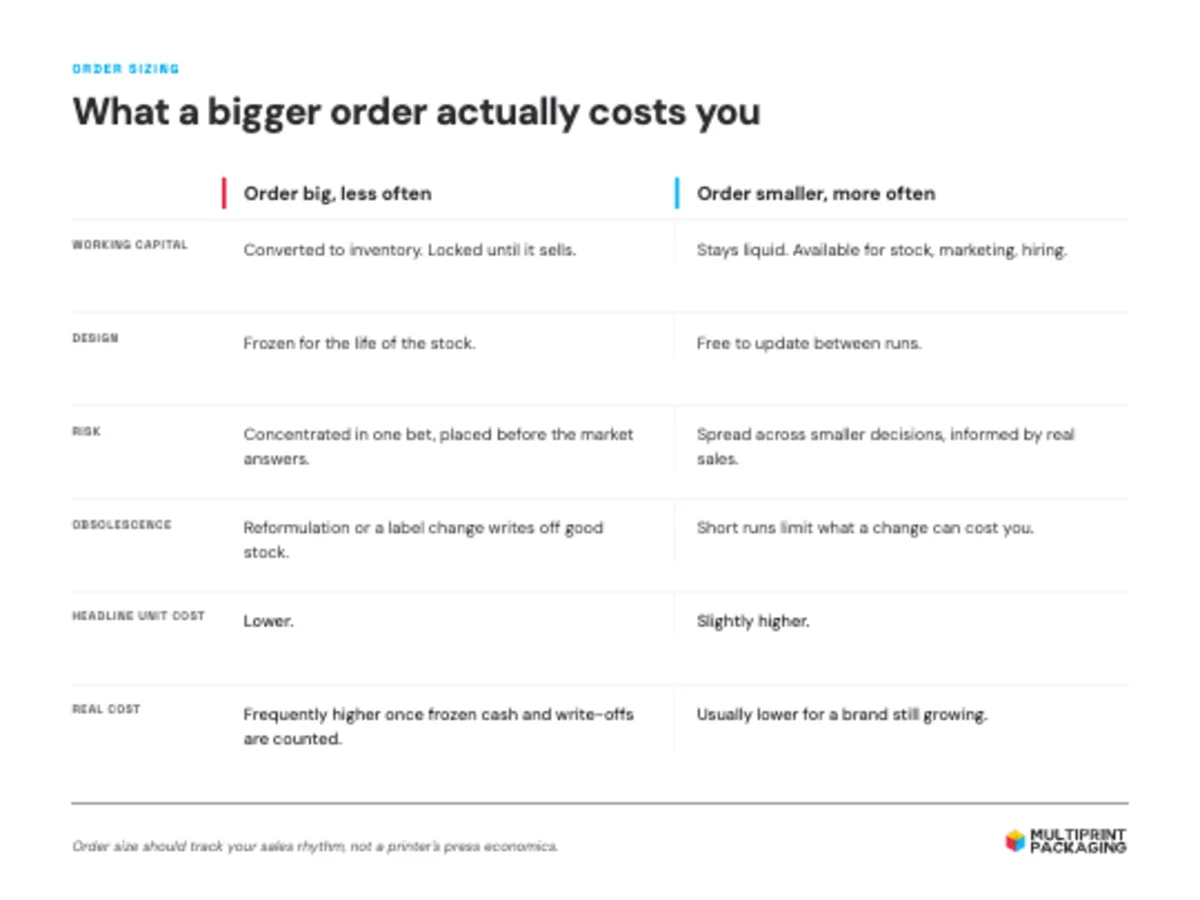
Your cash is frozen. Money spent on packaging that has not sold yet is money you cannot spend on stock, marketing, or hiring. For a growing brand, working capital is the constraint that governs how fast you can move. A large packaging order converts flexible cash into rigid inventory.
Your design is frozen too. The moment you commit to thousands of units, your artwork, your claims, and your formula are locked for as long as that stock lasts. If your branding evolves, if a regulation changes what your label must say, or if you reformulate, you are choosing between scrapping good stock or shipping packaging you have outgrown.
Your risk is concentrated. A high MOQ forces you to bet big on a single SKU before the market has told you whether it works. If the product underperforms, the packaging becomes a write-off. Brands that over-order on a new line are taking the largest possible bet at the exact moment they have the least information.
This is the hidden cost that never appears on the quote. The per-unit price might look efficient, but efficiency on paper is not the same as a healthy cash position in reality.
Quoted a minimum that does not fit your brand? Request a Quote and we will size an order around where you actually are.
Order to your sales rhythm, not the printer's minimum
The better way to size a packaging order is to ignore the printer's minimum entirely and start from a different question: how much do you actually sell?
Look at your real sales rhythm, the number of units you shift per SKU, per sales channel, over a rolling four, eight, and twelve weeks. That figure, not a supplier's press economics, is what should determine your order size. Order enough to cover your next selling window with a sensible buffer, ship it, sell it, and reorder. Your packaging order should track your sales, not gamble ahead of them.
If you are pre-launch and have no sales history yet, the principle still holds. Order a small, validating quantity to get the product on shelf and into customers' hands, learn what actually sells, then scale your reorders to the demand you have proven rather than the demand you hoped for.
This is the mindset shift that protects your cash: a packaging order is not a one-time bulk commitment you are forced into. It is a recurring decision you make in step with your sales.
The three ways to buy your packaging
In practice, a growing brand has three routes to market, and the right one depends on where you are in your journey rather than how many units a press demands.
Custom print on a standard size. The workhorse for most growing brands, and the right buy for the majority of brands taking a SKU to market. You get your own printed artwork on a proven, tooled standard size, which keeps the order accessible while giving you a fully branded pouch.
Plain stock for sampling and validation. The fastest, lowest-commitment route. Unprinted pouches in standard sizes let you test a format, run a sampling campaign, or validate fill and seal on your line before you commit to printed artwork. A sensible first step if you want to get moving before locking in a design.
Custom print on bespoke dimensions. The premium route, for when a standard size will not do and you need packaging built to your own specification. This is the upgrade you grow into once a SKU is established and you want a pack that is unmistakably yours.
The point of three routes is that you are never forced to over-commit. You choose the level of investment that matches your stage, and you step up as the brand earns it. The press technology behind these, whether digital for short runs and fast artwork iteration, HD flexo for medium-to-high volumes, or rotogravure for the highest volumes, is matched to your run rather than dictating it.
Want to start with samples before you commit to print? Request Plain Stock Pricing and get pouches in your hands.
Order smaller and more often: the cash-flow case
Once you are buying to your sales rhythm, a simple principle follows: ordering smaller quantities more often beats ordering large quantities less often, for almost every growing brand.
Smaller, more frequent orders keep your cash liquid. Instead of one large outlay that sits in inventory for months, you make smaller outlays that turn over quickly, which keeps working capital available for the things that actually grow the business. They also keep you flexible. If your design, formula, or labelling needs to change, you are only ever a short run away from updating it, rather than working through a mountain of obsolete stock first.
There is a trade-off to be honest about. A larger single run will usually carry a lower headline per-unit cost than several smaller runs, because of how production and setup are spread. But the per-unit saving on a bulk order is frequently wiped out by the cost of frozen cash, the risk of obsolescence, and the loss of flexibility. For a brand still growing and still iterating, the slightly higher unit cost of ordering little and often is usually the cheaper choice once you account for everything the bulk order ties up.
The brands that manage this well treat packaging as a flow that tracks demand, not a stockpile they sit on.
How to plan your first or next order
Whether this is your first packaging order or your tenth, the planning approach is the same.
Start with your sales rhythm. Work out, per SKU and per channel, how many units you realistically sell over four, eight, and twelve weeks. If you are pre-launch, estimate conservatively and plan to validate before you scale.
Pick the route that matches your stage. Plain stock to sample and validate, custom print on a standard size to take a SKU to market, bespoke dimensions once a line is established. You do not have to commit to your end-state on day one.
Size the order to your next selling window, plus a buffer. Cover the demand you can see, with a reasonable margin for upside, but resist the temptation to order far ahead of proven sales just to chase a lower unit price.
Build in your reorder lead time. Factor in how long production and delivery take for your format so you reorder before you run out, not after. Talk to your supplier about lead times up front so your reorder cadence is realistic.
Reorder against real demand. Once you have sales data, let it drive every subsequent order. Your packaging spend should rise and fall with your actual sales, never run ahead of them.
Done this way, the MOQ stops being a trap and becomes a non-issue. You order what you need, when you need it, and your cash stays where it does the most good: in the business.
Ready to size an order that fits your brand?
A high minimum order quantity is not a law of packaging. It is a symptom of a supplier whose press is the wrong fit for a growing brand. The right approach starts from how you actually sell, keeps your cash liquid, and lets you step up your commitment as the brand earns it.
Request Plain Stock Pricing to get samples in your hands and validate before you commit, or Request a Quote and we will help you size an order around your sales rhythm, not a printer's minimum.

Read next
More articles from our team





Get the next post in your inbox
Compliance updates, lead-time news, and packaging guides. One email, no spam
Ready to spec your pouch?
Get a quote for your format and see lead times for your region
Start your order
Whether you need custom print or plain stock, we've got lead times that work