
A founder's guide to budgeting realistic packaging lead times into a launch, with format-specific working-day figures you can plan around.
You picked a launch date. You picked a retailer slot. You picked an event. And then you went to your packaging supplier and asked: "When will it arrive?" The answer was vague. "Four to six weeks. Maybe sooner." So you booked the launch and crossed your fingers.
That is how packaging-related launch slips happen. Not from a single late delivery, but from a planning conversation that started with a soft answer to a question that needed a hard one. A growing brand cannot afford to plan a launch on a guess. You need a lead time you can actually trust, broken down by format, measured from a specific milestone, with the shipping leg counted separately.
This guide explains exactly how packaging lead times work, what drives the variation between formats, and the committed working-day figures you should plan around. The aim is simple: by the time you finish reading, you should know how to budget packaging into any launch schedule with confidence.
Why lead times slip, and why "four to six weeks" is not an answer
A vague lead time is not a small problem. It is the root cause of most packaging-related launch slips, and it usually has the same shape.
A supplier quotes a range, "four to six weeks", without specifying what the clock starts on or what is included. You plan to the lower end of the range, because that is what humans do. The supplier later confirms artwork on a different day than you assumed, or counts the shipping leg as part of the production time, or runs into a press scheduling conflict they did not flag. The order arrives at the top of the range, or beyond it, and your launch slips.
This is rarely about a supplier being unwilling. It is about a supplier being unwilling to commit. A range without a defined start point and a defined end point is not a lead time; it is a hope. The brands that protect their launches are the ones who insist on three pieces of information up front: the working-day figure for their specific format, the milestone the clock starts on (artwork approval, not order placement), and whether the figure includes or excludes shipping.
Once you have those three, lead times become a planning input, not a launch risk.
The committed lead times you should plan around
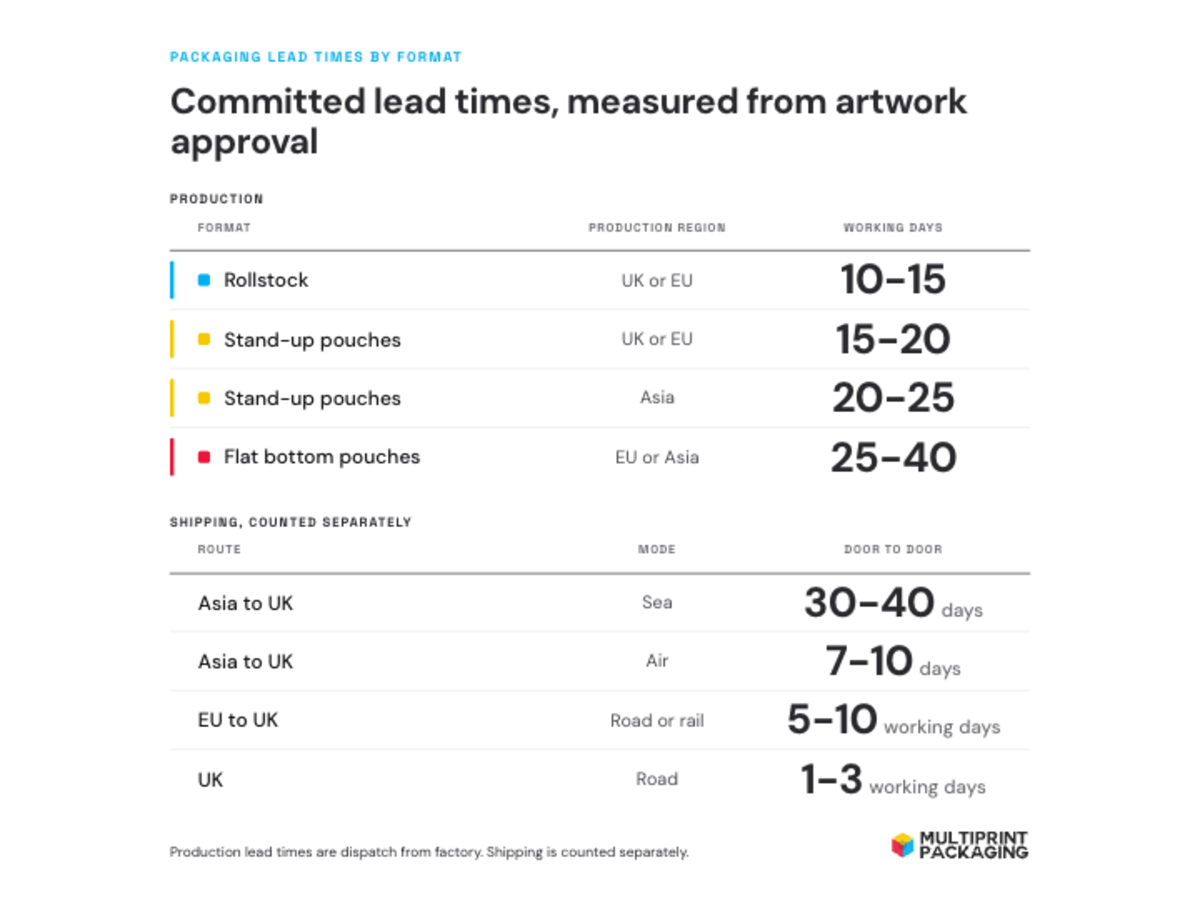
Lead times are not one number. They vary by format, by production region, and by what the press is set up to do. Below are the committed working-day figures you should plan to, measured from artwork approval to dispatch.
- Rollstock (UK or EU production): 10-15 working days
- Stand-up pouches (UK or EU production): 15-20 working days
- Stand-up pouches (Asia production): 20-25 working days
- Flat bottom pouches (EU / Asia production): 25-40 working days
A few things to note about these figures. They are measured from artwork approval, not from order placement, because the artwork sign-off is what releases the order to the press. They are production lead times, dispatch from the factory; the shipping leg from the factory to your warehouse is separate (see below). And the flat bottom format is not produced in the UK at all, the choice for FBP is EU or Asia, with the timing reflecting that.
These are the figures to plan to. If a supplier cannot give you committed working-day figures in this shape for your format, you cannot reliably plan a launch around their quote.
Need to plan a launch and want a committed lead time for your format? Request a Quote and we will give you the working-day figure for your specific job.
What drives the variation between formats
The reason rollstock can run in 10 to 15 working days and flat bottom takes 25 to 40 depending on region is not arbitrary. It comes down to the construction of each format and the press setup required.
Rollstock is the simplest format to produce. It is a single continuous web of printed film, supplied on a reel, with no forming, gusseting, or pouch conversion. Print, slit, ship. The fewest production steps means the shortest lead time.
Stand-up pouches add a forming and converting stage. After printing, the film is laminated, slit, formed into the pouch shape, gusseted at the base, and zippers or features are applied. Each step adds time and requires specific tooling. UK and EU production runs slightly faster than Asia for these formats, primarily because the shipping leg is short and the lead time you see is closer to the pure production time.
Flat bottom pouches are the most complex to produce. The five or six-panel construction (front, back, two side gussets, flat base, optional top panel) requires precision tooling and a longer setup. The base panel in particular is a separate construction step that simpler formats do not have. This is why FBP takes longer in any region, and why it is not made in the UK at all, the volume of FBP demand sits with specialist lines in the EU and Asia.
There is also a print-technology dimension. Multiprint runs three print technologies and matches the press to the run. Digital print has minimal setup per design, which makes short runs viable and keeps shorter formats moving fast. HD flexo and rotogravure carry more setup but are the right press for medium and high-volume runs respectively. The lead times above reflect the right press for the right job, not a single press doing everything.
Production lead time vs door-to-door: count them separately
This is where many founders trip up. The lead time figures above are production lead times, dispatch from the factory. They do not include the shipping leg from the factory to your warehouse, which has to be counted separately to avoid surprises.
The shipping leg depends on the production region and the shipping mode chosen:
- Asia to UK by sea: 40-50 days door to door
- Asia to UK by air: 7-10 days door to door
- EU to UK by road or rail: 5-10 working days
- UK road: 1-3 working days
The implication is straightforward. A flat bottom pouch produced in Asia and shipped by sea is a 25-40 working day production lead time plus a 40-50 day sea freight, giving a total door-to-door time of around two and a half to three months. The same FBP produced in the EU and shipped by road is 25-40 working days plus 5-10 working days, giving a total closer to six to ten weeks.
The choice between sea and air, or between Asia and EU production, is not just a unit cost decision. It is a lead-time decision too, and the two trade off against each other. For launches with a hard deadline, the right combination of region and freight mode is often more important than the per-unit saving.
When you plan a launch, plan to the total door-to-door time, not the production time alone.
The two milestones that matter most: frozen artwork and reorder lead time
Two specific dates do more to protect a launch than anything else: the frozen artwork date, and the reorder lead time.
Frozen artwork date. The lead times above are measured from artwork approval. That means the clock does not start until you have signed off the final print-ready artwork. Every day of artwork revision is a day added to your delivery. The single most common reason a launch slips is not slow production, it is artwork sign-off slipping. The solution is to set a hard "frozen artwork" date in your launch plan, work backwards from the launch date, and treat the artwork sign-off as the milestone the rest of the schedule depends on.
Reorder lead time. Once you are in market, the lead time becomes the constraint on continuity. If your format takes 20 working days to produce plus shipping, you need to place your reorder before your existing stock falls below that threshold, not after. The brands that run out are usually the ones that treat reordering as a reactive task. The brands that don't run out reorder against their actual sales rhythm, with the format's lead time built into the trigger point. Talk to your supplier about your reorder cadence at the same time you talk about your first order, so the planning is in place from day one.
Both of these are linked to the cash-flow and order-sizing logic that drives everything else in your packaging planning. We cover that side in our guide to flexible packaging MOQs.
Working backwards from a launch date? Request Plain Stock Pricing for samples and Request a Quote for committed working-day timing on your format.
How to build packaging into a launch schedule
Putting it all together, here is the planning sequence that protects a launch.
Start from your launch date and work backwards. Take the hard deadline (a retailer listing date, an event, a campaign go-live) and use it as the anchor for the schedule.
Add the door-to-door shipping leg. Whatever production region you are using, add the realistic shipping time to your warehouse. Use the figures above as a starting point.
Add the production lead time for your format. Use the committed working-day figures (Rollstock 10-15, SUP UK/EU 15-20, SUP Asia 20-25, FBP EU/Asia 25-40), measured from artwork approval.
Set a frozen artwork date earlier still. Build in a sensible buffer for artwork rounds and sign-off. Treat this as the date the rest of the schedule cannot move.
Confirm format and supplier capacity before you commit. Talk to your packaging supplier early in the planning, not late. A committed slot on press is more valuable than a slightly cheaper quote you cannot book a press for.
Plan the reorder cadence at the same time. Decide upfront when you will reorder and what trigger point in your stock level will release the next order. Lead times are easier to manage when they are part of an ongoing rhythm, not a one-off scramble.
Done in this order, packaging stops being the thing that slips your launch and becomes one of the more predictable parts of it.
Ready to plan a launch with lead times you can trust?
The brands that hit their launch dates are not the brands with the fastest packaging suppliers. They are the brands with the most honest ones. A committed working-day figure for your specific format, measured from artwork approval, with the shipping leg counted separately, is what makes the difference between a launch that lands and one that slips.
Request Plain Stock Pricing for samples to validate your format, or Request a Quote and we will give you a committed lead time for your job, so you can plan a launch around timing you can trust.

Read next
More articles from our team





Get the next post in your inbox
Compliance updates, lead-time news, and packaging guides. One email, no spam
Ready to spec your pouch?
Get a quote for your format and see lead times for your region
Start your order
Whether you need custom print or plain stock, we've got lead times that work