
You spend weeks debating the barrier film, the finish, and the print. Then the zipper gets chosen as an afterthought. It is the most frequently used functional element of any resealable pouch, and it is where a brand most often disappoints the consumer.
The zipper is the part of your packaging your customer touches every single day. If it fails, frustrates, or clogs, that is the experience they associate with your brand, not the barrier spec you laboured over. At the same time, if the zipper is incompatible with your filling line, it becomes an operations problem that drives up reject rates and downtime.
This guide breaks down the main zip types available for flexible packaging, what each is for, and how to match the right closure to your product, your consumer, and your filling line.
Why the Zipper Decision Is Not an Afterthought
One of the most common complaints from consumers of supplement and pet food brands is zipper failure or difficulty. It is almost always avoidable with the right specification.
A zipper that frustrates the consumer is a brand problem, not a packaging detail. When a customer cannot reseal the pouch because the zipper groove is clogged with powder, they blame the brand. The zipper choice must satisfy three audiences at once: the consumer who uses it daily, the operations team who fill it, and the brand that lives with the reviews.
For operations, a zipper that is incompatible with the filling line, or that sits outside placement tolerance, drives up reject rates, downtime, and rework costs. The zipper is a critical component of the production process, not a finishing touch.
The Main Zip Types
Press-to-Close Zipper (PTC)
The press-to-close (PTC) zipper is the industry standard: two interlocking profiles the consumer presses together to reseal. It is universally compatible with filling lines, cost-effective, and familiar to every consumer. It is the right default for dry goods, capsules, gummies, and treats.
Its one weakness is fine powder. Particles accumulate in the profile over repeated openings and compromise the reseal. For any fine powder product, the answer is a powder-proof zipper.
Powder-Proof Zipper
A powder-proof zipper is a specialist press-to-close zipper engineered to stay sealable around fine powders. Standard PTC profiles trap protein, creatine, greens, and collagen particles in the groove, and over time the reseal fails. Powder-proof zippers solve this through profile engineering, not a cover flap, so the consumer experience stays simple while reseal integrity is preserved across the life of the pack. It is the default recommendation for all fine powder formats.
Child-Resistant Zipper (CR)
A child-resistant (CR) zipper requires two deliberate, simultaneous actions to open, meeting the BS EN ISO 8317 standard. It is the right choice for regulated categories, but it deliberately trades consumer ease for safety, so it should only be specified where a regulatory or retailer requirement applies. The brand is responsible for confirming whether CR applies to its specific product before specifying. Multiprint supplies CR-certified zippers but does not advise on whether your product requires one.
Pocket Zipper
A pocket zipper is a press-to-close profile attached to one panel of the pouch rather than spanning both sides of the opening. Because it bonds to one panel, product can be filled past the zipper line without fouling it, and externally the pouch is uninterrupted by a visible zipper line, giving a clean premium appearance. The reclosure experience is the same as a standard press-to-close. Pocket zippers are most common on coffee flat bottom pouches, where the premium format and clean pack face are the whole point. They also suit pet food and any brand whose exterior design should not be broken by a zipper line, with the tamper-evidence bonus of a first-open signal without a separate seal. For fine powder supplements, powder-proof is the most popular and reliable choice for powder products, because reseal integrity around fine particles matters more than a clean exterior. A pocket zipper can still be supplied on a supplement pouch if a brand requests it.
Easy-Tear Opening
While not a zipper type, an easy-tear opening is a critical companion specification, especially for mono-material structures. The recommended approach for mono-material structures is a linear tear: a profile that gives a clean, guided first open. Without it, mono-material pouches can struggle on first open regardless of zipper quality. For any product moving to PE/PE mono-material film, an easy-tear specification is mandatory.
Heat Seal Only: No Zipper
Not every pouch needs a zipper. Single-use formats such as sachets and stick packs are heat-sealed with a tear notch and need no reclosure at all. Do not add a zipper just because it looks premium if the product use case does not call for one.
Zipper Choice by Product Category
Nutritional supplements
- Fine powder products (protein, pre-workout, creatine, greens, collagen): powder-proof zipper. The default for all fine powder formats; standard PTC is second choice only.
- Capsules and tablets: PTC zipper standard. CR where a regulatory or retailer requirement applies.
- Sachets and stick packs: heat seal with tear notch. No zipper required.
- Gummies: PTC zipper. Specify a wide groove profile for sticky products.
- Premium supplement brands prioritising a clean pack aesthetic: pocket zipper.
- Any product moving to PE/PE mono-material film: easy-tear specification mandatory.
Pet food (dry)
- Treat formats and training packs: PTC zipper with hang hole for retail peg merchandising.
- 1kg to 6kg multi-serve dry food: pocket zipper standard across stand-up and flat bottom formats.
- Single-serve sample sachets: tear notch, no zipper.
- Premium flat bottom pet food brands: pocket zipper for a clean exterior aesthetic.
- Any format moving to mono-material PE/PE: easy-tear specification mandatory.
Coffee
- All resealable formats: PTC zipper with degassing valve, the standard combination for speciality coffee.
- Premium flat bottom roasters: pocket zipper for a clean pack aesthetic.
Other regulated categories
- CR zipper required: confirm certification against BS EN ISO 8317. The brand is responsible for confirming whether CR applies to its specific product category.
The Operations Director Perspective
Filling line compatibility. Confirm the zipper type with your line manufacturer before specifying it with your packaging supplier. This is the single most common and most costly mismatch in flexible packaging operations. PTC and powder-proof zippers are universally compatible with VFFS and HFFS lines. CR zippers require confirmed placement tolerance, typically a wider zipper zone than standard PTC. Pocket zippers require pocket depth and placement confirmation at the sample stage, so do not approve a pocket zipper spec without a filled sample run on your line. Easy-tear must be specified at the film structure stage; confirm tear force and tear direction before production approval.
Placement tolerance. Zipper placement from the top seal must be consistent batch to batch. Specify a tolerance in your purchase order. Inconsistent placement creates seal integrity failures and consumer complaints, and it is a supplier quality control issue if placement varies beyond the specified tolerance.
Powder contamination. Fine powder products accumulate in standard PTC zipper profiles and compromise reseal over time. This is the primary driver for powder-proof zipper specification on supplement products. Specify powder-proof as the default for all fine particle products. The marginal cost difference is significantly less than the consumer complaint rate from a contaminated PTC profile.
What is the best zipper for protein powder pouches?
For protein powder and other fine powder supplements, the powder-proof zipper is the best choice. It is engineered so powder does not accumulate in the zipper grooves, ensuring the pouch can be securely resealed throughout its lifespan.
Do supplement pouches need child-resistant zippers in the UK?
Only where a regulatory or retailer requirement applies, typically for high-dose iron supplements and certain high-dose vitamins and minerals. Whether your specific formulation triggers a child-resistant requirement is a regulatory question for you and your adviser, not a packaging decision. Multiprint supplies CR-certified zippers to BS EN ISO 8317 but does not advise on whether your product requires one.
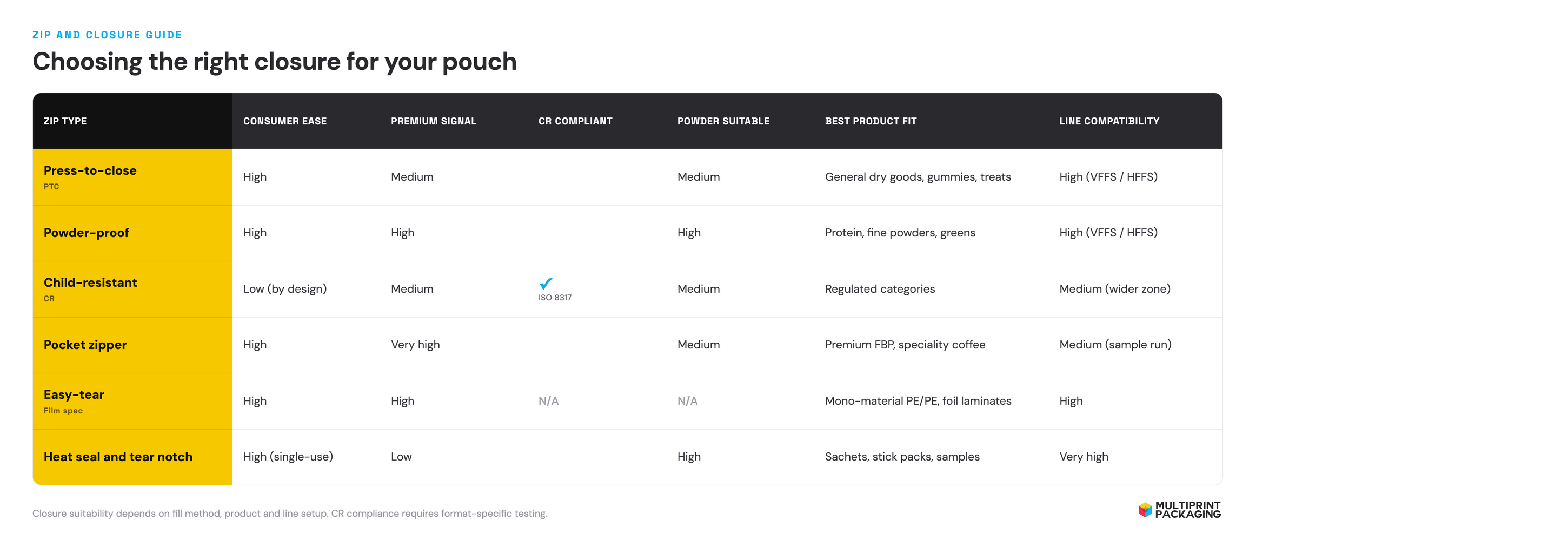
Compare Pouch Zip Types
Use this table to match the closure to your product, your consumer, and your filling line. Confirm CR certification and line compatibility before specifying.
The zipper is the part of your pack the customer meets every day. Get it right and it disappears into a good experience; get it wrong and it becomes the review. If you want it matched to your product and filling line, Request Plain Stock Pricing to get samples in your hands, or Request a Quote for your project.

Read next
More articles from our team






Get the next post in your inbox
Compliance updates, lead-time news, and packaging guides. One email, no spam
Ready to spec your pouch?
Get a quote for your format and see lead times for your region
Start your order
Whether you need custom print or plain stock, we've got lead times that work